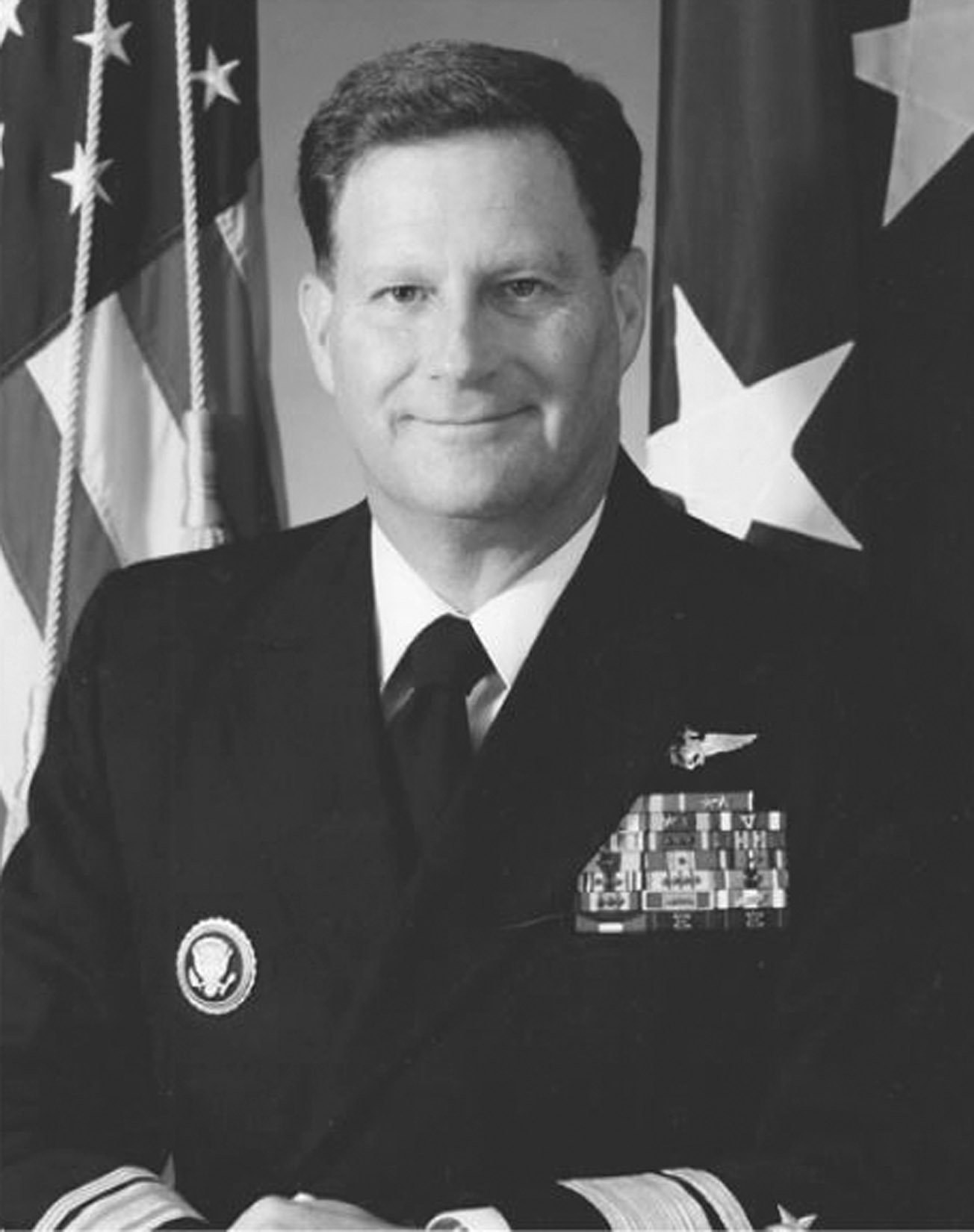
RADM Jay Bradford YAKELEY III, USN (Ret),
Golden Eagle Emeritus |
It is my sad duty to inform you that at 0630, Sunday, 8 March 2026, Golden Eagle Emeritus RADM Jay B. “Spook” YAKELEY III, USN (Ret), made his Last Take Off at the Martinsburg VA Memory Care facility in Martinsburg, West Virginia. Jay suffered from frontotemporal dementia. He was 81 years of age. |
Jay was born in Phoenix, Arizonia, in January 1945, the son of Navy CAPT J.B Yakeley Jr. and his wife Mary. His father served in World War II and the Korean War. On graduation from high school, Jay attended Loras College, a private Catholic liberal arts college in Dubuque, Iowa. He earned a Bachelor of Science degree in Economics, graduating in 1966. In June 1966 he enlisted in the U.S. Naval Reserve, in the Aviation Officer Candidate School program, reporting for active duty in November 1966. In February 1967 he was designated an Ensign and began flight training at NAS Pensacola, Florida. He completed advanced flight training at VT-25, NAAS Chase Field, Beeville, Texas, flying the TF-9J Cougar, earning his Wings of Gold on 27 May 1968. In July 1968 he reported to the VT-9 Tigers, NAS Meridian, Mississippi, for duty as a flight instructor, flying the T-2A and T-2C Buckeye. |
In October 1969 Jay reported to VF-101 at NAS Oceana, Virginia, for transition training in the F-4 Phantom II, and then in August 1970 to his first fleet squadron, the VF-74 Be-Devilers, flying the F-4B and F-4J. The squadron deployed aboard USS America (CVA 66) from June 1972–March 1973 for combat operations in Vietnam, flying seven line periods from Yankee Station. During this time Jay flew 125 combat missions. Detaching from the Be-Devilers in April 1973, Jay next reported to Naval Plant Representative Office (NAVPRO) at Grumman Aerospace Corporation, Bethpage, and Calverton, Long Island, New York, as the Operations Officer. While there he flew the F-14A Tomcat on acceptance flights of aircraft off the production line. During that same period, he also earned a Master of Science degree in Economics from the University of New York at Stony Brook. Completing this tour in December 1975, Jay made the cross-country move to San Diego, California, to join VF-124, the F-14 fleet replacement squadron at NAS Miramar for replacement pilot training. Reporting to the VF-2 Bounty Hunters in June 1976, Jay served as the Assistant Operation Officer and Safety Officer. Deploying aboard USS Enterprise (CVN 65) in July 1976 for a WESTPAC and Indian Ocean deployment, the ship/air wing team returned home in late March 1977. After completing turn-around training the ship/air wing team deployed for another WESTPAC from April–October 1978. Jay departed the Bounty Hunters in December 1978, reporting back to the VF-124 Gunfighters as an instructor pilot and department head, flying the F-14. |
In June 1981, Jay joined the VF-114 Aardvarks as the Executive Officer, at NAS Miramar, flying the F-14. He joined mid-deployment aboard USS America (CV 66) in the Indian Ocean/North Arabian Sea, returning to America’s homeport of Norfolk, Virginia, in November 1981, with the squadron making the cross-country flight home to NAS Miramar. During their turn-around training, the squadron won the “High Noon” aerial gunnery competition for the west coast, and the “Mutha” trophy as best west coast F-14 squadron. Jay assumed command of the Aardvarks in August 1982. A month later the squadron deployed aboard USS Enterprise for a WESTPAC deployment, that included two weeks of operations with the USS Midway (CV 41) and USS Coral Sea (CV 43) in the Northern Pacific. Completing that deployment in April 1983, the squadron once again won the “High Noon” and “Mutha” competition during turn-around training, the first F-14 squadron to win both these awards two years in a row. Completing his command tour in February 1984, Jay next reported to the Naval War College in Newport, Rhode Island as a student. |
In June 1984, Jay reported to the Pentagon, Office of CNO, OPNAV staff, for a two-year tour where he was Assistant Air Warfare Analyst and then Head Air Warfare Analysis Section. Achieving escape velocity in May 1986, he moved back to NAS Miramar and assumed command of the VF-124 Gunfighters, the west coast fleet replacement squadron. In October 1987 he assumed command of the Navy Fighter Weapons School (TOPGUN), also located at NAS Miramar, for a twenty-month tour. Departing TOPGUN in July 1989, he was temporarily assigned to COMNAVAIRPAC while completing his training pipeline en route to command Carrier Air Wing Fourteen, which he assumed in November 1989. Deploying aboard USS Independence (CV 62) in June 1990 for a routine WESTPAC, the ship/air wing team responded to Iraq’s invasion of Kuwait, arriving in the Gulf of Oman on 5 August 1990, and then sailed into the Persian Gulf. Indy was the first carrier to enter the Persian Gulf since 1974. Remaining on station for 112 days in support of Operation Desert Shield, the ship/air wing team returned to San Diego on 20 December 1990. |
Relinquishing command in May 1991, Jay reported in July 1991 as the Senior Military Officer in the White House as Deputy Director of the White House Military Office, where he served both Presidents Bush and Clinton. In October 1993, he commenced temporary additional duty at U.S. Naval Forces Central Command serving as the Deputy Commander Joint Task Force Southwest Asia, Riyadh, Saudi Arabia, until March 1994. He then assumed command of Carrier Group Three, based at NAS Alameda, California, for the next sixteen months. USS Abraham Lincoln (CVN 72) was the flagship, and the battlegroup deployed for a WESTPAC/Indian Ocean deployment in April 1995. Jay completed this command tour on deployment, departing in July 1995, reporting to CINCPAC (now PACOM) as the J-3, Director for Operations, at Camp Smith, Hawaii. Jay’s final active-duty tour began in September 1996 back in Washington, D.C., in the Pentagon, in the Office of the CNO, OPNAV, where he was Director, Programming Division, N-80. In that billet he was responsible for the Navy’s $105 billion/year budget and the $675 billion five-year defense plan (FYDP) program. He retired on 1 March 1999. |
Over the course of Jay’s 33-year active-duty career, he amassed over 6,500 flight hours, 1,250 carrier arrested landings, and flew 125 combat missions over Vietnam. His combat decorations include the Air Medal w/ Numeral 7 and the Navy Commendation Medal w/ Combat “V”. He was the first F-14 acceptance test pilot at NAVPRO as the new fighter came off production lines. Jay had five aviation commands, commanding VF-114, a bonus command of VF-124, command of TOPGUN, of Carrier Air Wing Fourteen, and of Carrier Group Three. In addition, he was the Deputy Commander of Joint Task Force Southwest Asia. While not every tour of his career allowed him to fly, he clearly made the most of every tour that did include flying, as evidenced by his total flight time and carrier landings. He did lead from the air. |
After retirement from the Navy, Jay remained in the northern Virginia area, doing some consulting work, including with the Johns Hopkins Applied Physics Laboratory on precision strike and power projection projects prior to beginning a second career with Computer Sciences Corporation. |
Jay is survived by his wife, Evelyn, his brother, Naval Aviator CDR Bob Yakeley, USN (Ret), and sisters Pat Wieber of Chicago, Illinois, and Stephanie Danforth of Martha’s Vineyard, Massachusetts. Jay will be interred at Arlington National Cemetery at a future date and.that information will be provided in a Special Notice when known. |
He will be missed. |
In sadness,
Marty CHANIK
Pilot |
|
