|
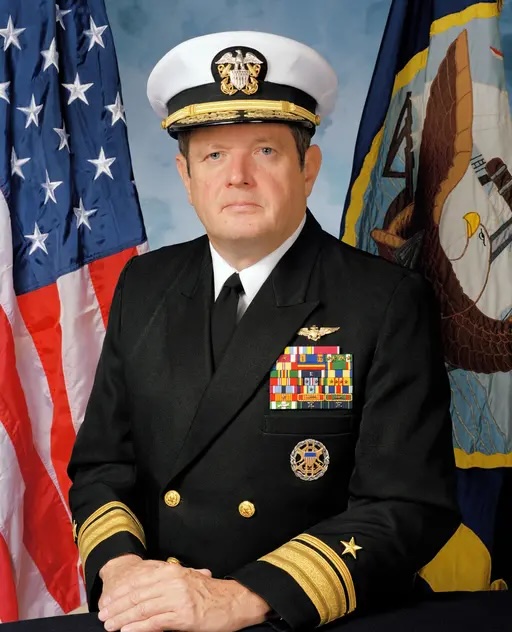
Rear Admiral David N. ROGERS, USN (Ret)
Golden Eagle Emeritus
Gentlemen,
It is my sad duty to inform you that on Friday, 12 December 2025, Golden Eagle Emeritus RADM David N. ROGERS, USN (Ret), made his Last Take Off in Alexandria, Va., with his wife, Barbara, by his side. Dave suffered several major strokes during the Thanksgiving holiday. He was 89 years of age.
Dave was born Oct 1936 in Chicago, Ill. At a young age the family moved to the Washington, D.C. area where Dave grew up, attending and graduating from St. John’s College High School in 1954. He credited his Catholic education and experiences in the cadet program as providing him the foundation for future success. He attended Georgetown University for one year before entering the U.S. Naval Academy in June 1955. While on summer deployment, he participated in the amphibious landings in Lebanon.
Graduating from USNA in June 1959 with a Bachelor of Science degree in Electrical Engineering, Dave spent several months at the Academy instructing in seamanship and navigation prior to reporting to NAS Pensacola, Fla., for flight training in September 1959. While at the Academy, Dave gained some flight time in the N3N (bi-plane trainer aka “Yellow Peril”) and the UF (Grumman Albatross). During his flight training in Pensacola and Beeville, Texas, Dave flew the T-34 Mentor, T-28 Trojan, F-9 Cougar, and F-11 Tiger, earning his Wings of Gold on 12 April 1961. Of special significance while in flight training, in 1960, Dave married the love of his life, Barbara, whom he had grown up with in the same childhood neighborhood.
His first operational squadron was the VA-36 Roadrunners, NAS Cecil Field, Fla., reporting in November 1961 after completing A-4 Skyhawk transition training at the VA-44 fleet replacement squadron. Flying the A-4C from USS Saratoga (CVA 60), Dave completed two deployments to the Mediterranean Sea, one from November 1961–May 1962, and the second from March 1963–October 1963. He noted that on one of those deployments he flew a section over Soviet Albania and had to escape four MiG-15s by diving into the clouds and evading back to the ship. As a first tour aviator, besides performing as a division officer, he also served as the Operations Officer for a period of time. Between the two deployments, the ship/air wing team was engaged in the Cuban Missile Crisis, where Dave planned and flew missions. After this somewhat eventful first tour, his next assignment was to the U.S. Naval Postgraduate School, Monterey, Calif., in November 1964, where he earned a Bachelor of Science in Aeronautical Engineering and remained current flying the T-2 Buckeye, T-28 Trojan, and the C-45 Expeditor.
In October 1966, Dave reported to the VA-125 Rough Raiders, NAS Lemoore, Calif., as an instructor and weapons pilot, flying the A-4 and A-1 Skyraider. He noted that during this tour he landed an A-1, at night, in a snowstorm, at the closed Tonopah Airport, which certainly had to be somewhat exciting. In July 1968, Dave began his department head tour, joining the VA-93 Blue Blazers (later the VA-93 Ravens), mid-deployment aboard USS Bon Homme Richard (CVA 31) on a Vietnam War deployment, flying the A-4F. Returning home to NAS Lemoore in October 1968, the squadron then transitioned to the A-7B Corsair II and deployed for another combat cruise aboard USS Ranger (CVA 61) in October 1969, returning home in June 1970. During these two deployments Dave flew 209 combat missions. On return home, Dave detached to report to his next duty assignment, to BuPers in Washington, D.C. as the Aviation LCDR/Junior Officer detailer, arriving in July 1970. While there he managed to fly the A-4 and A-7 and had a temporary duty assignment to Vietnam in support of HAL-3, most likely the squadron shutdown process beginning in 1972, where he flew the OV-10 Bronco and H-2 Seasprite in combat, and saw combat on the ground, and was awarded the Combat Action Ribbon. On completion of his BuPers tour in August 1972, Dave reported to VA-122, the Lemoore based fleet replacement squadron, for A-7 refresher training. In May 1973 he began his XO/CO tour with the VA-192 World Famous Golden Dragons flying the A-7E and deploying aboard USS Kitty Hawk (CV 63) for two WestPac deployments; the first from November 1973–July 1974 during which the ship/air wing team demonstrated the new CV concept. Dave assumed command in July 1974, leading the squadron to a Battle ‘E’ during his tenure. Notably, he also landed a T-28 with an engine failure on a highway in the Mojave Desert. He departed this successful command tour mid-deployment in October 1975.
Dave’s follow-on assignment was back to BuPers as the Head, Air Combat Placement, where he again maintained currency in the A-4 and A-7. This two-year assignment culminated with Dave taking command of Carrier Air Wing 14 in July 1978 mid-deployment in WestPac aboard USS Enterprise (CVN 65). The Carrier Air Wing deployed again to WestPac in November 1979 aboard USS Coral Sea (CV 43), with Dave departing command in December 1979. As the Carrier Air Wing commander, he flew all air wing aircraft (A-6 Intruder, A-7 Corsair II, EA-6 Prowler, F-4 Phantom II, F-14 Tomcat, RF-8 Crusader, RA-5C Vigilante, E-2 Hawkeye, S-3 Viking, and the SH-3 Sea King). Reporting to COMNAVAIRPAC as the Carrier Air Wing Training Officer in Dec 1979, he maintained currency in the A-7. Six months in the tour he began his training track for deep draft command, assuming command of USS Okinawa (LPH 3) in December 1980, homeported in San Diego, Calif. He deployed to WestPac/Indian Ocean from Jun–Dec 1981, and flew in the H-1 Huey, H-2, H-46 Sea Knight, H-53 Sea Stallion, and the AV-8 Harrier. Okinawa was awarded the Battle ‘E’ under his command. Departing Okinawa in March 1983, Dave then assumed command of USS Kitty Hawk (CV 63) in May 1983. The ship deployed for WestPac/Indian Ocean/North Arabian Sea from January–August 1984, with Dave flying the A-7 and F-14. In March, in a widely reported incident, Kitty Hawk collided with a Soviet Victor I submarine in the Sea of Japan when the submarine unexpectedly surfaced directly in front of Kitty Hawk. The sub remained afloat and did not require or request assistance. Part of the sub’s propellor was removed from Kitty Hawk’s bow in Subic Bay. With Dave in command, Kitty Hawk was awarded the Battle ‘E’.
With a change of command in August 1984, Dave next reported to Commander, Seventh Fleet in Yokosuka, Japan as the Chief of Staff for ten months before reporting to the Pentagon and the Joint Staff in June 1985 as Deputy Director, National Military Command Center and then as Deputy Director, Current Operations (J-3) and finally as Vice Director of Operations (J-3). . In those billets he was the senior planner for Operation El Dorado Canyon (joint strike on Libya) and led the investigation team following the Iraqi strike on USS Stark (FFG 31) to determine what happened and how to prevent a reoccurrence and determine reparations. Departing the Joint Staff in August 1987, Dave completed the training track to take command of Carrier Group Three, NAS Alameda, Calif., in December 1987. Deploying aboard USS Carl Vinson (CV 70) from June–December 1988, the strike group supported Operation Earnest Will, the escort of U.S.-flagged tankers in the Persian Gulf. Dave remained current in the F-14, A-7, and A-6. With his change of command in February 1989, he reported back to the Pentagon to OPNAV as OP-05B, Deputy Assistant CNO, Air Warfare, and once again managed flight time in the F/A-18 Hornet and A-7. Dave’s final active-duty tour was as Commander, U.S. Naval Forces Central Command Rear, which he assumed in July 1991, and where he planned and was Deputy Commander for Joint Task Force Southwest Asia, enforcing the no-fly zone over southern Iraq. And fittingly so, he managed some more flight time in the F/A-18, F-15 Eagle, and the GR-1Tornado. Dave retired from active duty on 1 September 1993.
In his 34-year Naval Aviation career, Dave flew 5,303 accident-free flight hours, made 1,411 carrier arrested landings, 110 rotary wing landings, and flew 211 combat missions. He flew a total of 63 aircraft, 19 of those from the decks of 16 different aircraft carriers. He managed to remain flying in virtually every billet of his career, including his six commands. His combat awards include the Air Medal with one Gold Star and numeral “17”, 5 Navy Commendation Medals with Combat “V”, and the Combat Action Ribbon.
Following his retirement from active duty, Dave joined Kapos & Associates as the Director of Studies for three years and then became a Senior Vice President and General Manager for Titan Corporation for the next 10 years. He was also a Senior Fellow for the Joint Forces Staff College for three plus years and a Senior Vice President for Northpointe LLC for more than a year. Dave established his own consulting firm of Rogers & Associates. He was an active supporter of the Institute of World Politics, a school dedicated to educating future leaders in international affairs and national security.
Dave is survived by his beloved wife and childhood friend Barbara, and their children, Glenn and Cindy, and by five grandchildren and two great-grandchildren. There will be a viewing on Friday, 23 January 2026 from 1800–2000 at the Murphy Funeral Home, 4510 Wilson Boulevard, Arlington, VA, 22203. The funeral Mass will be Saturday, 24 January 2026 at 1230 at The Cathedral of Saint Thomas More, 3901 Cathedral Lane, Arlington, VA, 22203. Interment will be at Arlington National Cemetery at a future date. That information will be provided in a Special Notice when known. Memorial contributions may be made to the Navy Marine Corps Relief Society or a charity of your choice.
He will be missed.
In sadness,
Marty CHANIK
Pilot
|

_files/intuit-mc-rewards-2.png "Mailchimp Email Marketing")